دليل الجيب · 01 · الصفحات 13–28
الإمبراطورية الرومانية
From foundation to fall. The world that gave rise to Hagia Sophia.
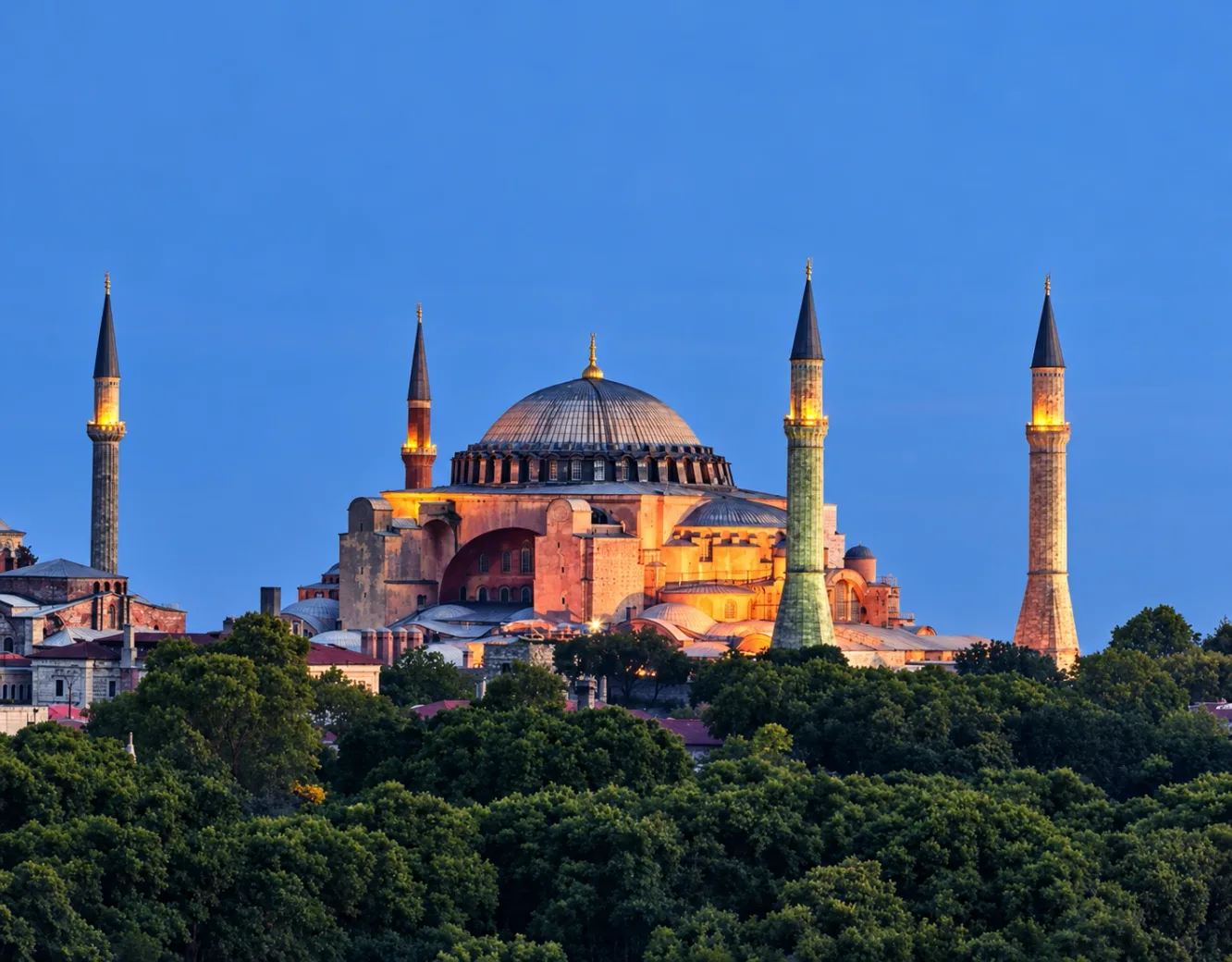
النص الإنجليزي الأصلي كاملًا. يعكس التعليق التاريخي والعقدي منظور الكتاب المصدر.
الفهرس والتنقّل
The Roman Empire
From Foundation to Fall A Historical Review (753 BCE -1453 CE)
An empire that existed for 2205 years: The Roman Empire began as a small settlement in Rome (central Italy) and grew into one of the most powerful empires of the ancient world.
■ The Roman Kingdom (753 BCE – 509 BCE).
■ The Roman Republic (509 BCE – 27 BCE).
■ The Roman Empire (27 BCE - 1453 CE).
The Roman Empire formally split in 395 CE into the Western Roman Empire (which fell in 476 CE) and the Eastern Roman (Byzantine) Empire (which fell in 1453 CE).
Romans worshiped many gods: Before their conversion to Christianity, the dominant religion in the Roman Empire (both West and East) was Roman polytheism, a complex system of gods and goddesses, rituals, and cults largely influenced by Greek mythology.
The word “pantheon” comes from the Greek words: “pan” (meaning “all”) and “theos” (meaning “god”). So, when we say the Romans worshipped a “pantheon of deities”, it means they worshipped a collection or family of many different gods and goddesses,
Ancient Rome worshiped a polytheistic pantheon headed by the Capitoline Triad: Jupiter (god of sky and state), Juno (queen of the gods and protector of women), and Minerva (goddess of wisdom and strategy). Alongside major figures like Mars (war), Venus (love), and Apollo (light and prophecy), the Romans routinely absorbed local deities from conquered lands, viewing the favor of the gods as essential to imperial power.
Jesus birth and life (1-33CE): Jesus was born in Bethlehem during the reign of Augustus, the first Roman Emperor, and was later raised in Nazareth. Upon beginning his public ministry at age thirty, he encountered significant opposition from the Jewish religious leadership. According to Christian tradition, his life ended in crucifixion (April 33 CE) under the authority of Emperor Tiberius, as ordered by Pontius Pilate, the Roman governor of Judea.
Constantine I, the first Roman Emperor who converted to Christianity (312 CE): It was just before the Battle of the Milvian Bridge. It is narrated that he had a dream where he was instructed to place the Christian symbol (the Chi-Rho) on his soldiers’ shields.
Edict of Milan (313 CE) and the foundation of Constantinople: After winning the civil war, Constantine issued the Edict of Milan (i.e. formal rule, 313 CE), ending the state-sanctioned persecution of Christians.
Arianism and the various views about Jesus’s divinity and his relationship to God: Arianism was propagated by Arius (the early 4th century), a minister of the Christian Church from Alexandria. He rejected trinity and taught that Jesus was a “created being by God” and not co-eternal or co-equal with Him.
The opposing trinitarian view argued that Jesus Christ was co-eternal and co-equal with God the Father, of the same divine substance. To deny this was to undermine the very nature of salvation and the divinity of Christ.
This significant theological challenge ultimately necessitated the convening of the Council of Nicaea in 325 CE, which aimed to establish a definitive understanding of Christ’s nature and paved the way for the eventual formalization of the Trinitarian doctrine.
Council of Nicaea (325 CE): The main outcome of the First Council of Nicaea in 325 CE was the creation of the original Nicene Creed, which established the core Christian doctrine that Jesus is of the same substance (homoousios) as God the Father
While Nicaea laid the groundwork for Trinitarian theology, the full doctrine of the Trinity— affirming one God in three Persons (Father, Son, and Holy Spirit)—was completed decades later at the Council of Constantinople in 381 CE.
The New Rome in Constantinople: To better manage the empire’s wealth and defend its eastern borders against Persia, he moved the capital from Rome to the strategic city of Byzantium. Renamed Constantinople (330 CE), this “New Rome” was built to be a Christian metropolis, free from the pagan traditions and political influence of the old Roman Senate. (this
paved the way for the establishment of the first Hagia Sophia
in 360 CE).
Constantinople
Constantine I passes away in 337 CE: He reigned from (306 – 337 CE) and he was baptized on his deathbed by an Arian non-trinitarian bishop
(Eusebius of Nicomedia).
When Constantine I died, his son Constantius II took over the Eastern part of the Empire. He was a strict Arian non-trinitarian and actively persecuted Nicene Christians.
Arianism and Nicene Creed: Arianism is an early Christian theological teaching that denied the full divinity of Jesus Christ, asserting instead that he was a created being. He was created by God the Father. However, the Nicene Creed, established the core Christian doctrine that Jesus is of the same divine substance of God.
Edict of Thessalonica (380 CE): Emperor Theodosius I made Trinitarian Christianity the official state religion of the Roman Empire by issuing the Edict of Thessalonica in 380 CE, which declared Nicene Christianity (the form
of Christianity defined at the Council of Nicaea) as the
official state religion of the Roman Empire. This effectively outlawed other forms of Christianity
(like Arianism which rejects trinity) and traditional
Roman polytheistic practices. Therefore, both the Western and Eastern Roman Empires were predominantly trinitarian Christian after 380 CE.
Closing of Pagan Temples (391 CE): Emperor Theodosius I enacted strict legislation banning traditional sacrifices and official temple rituals. This initiated a gradual, multi-decade process across the empire that systematically phased out public pagan practices in favor of Nicene Christianity.
The split of the Roman Empire into East and West (395 CE): As the empire grew, it became increasingly difficult to manage. In 395 CE, the Roman Empire officially split into two distinct entities: Western and Eastern. The capital of the Eastern Roman Empire was Constantinople
(modern-day Istanbul). The Eastern Roman Empire
was later called the Byzantine Empire.
The fall of the Western Empire (476 CE): The Western Roman Empire faced increasing internal problems and external pressures from barbarian invasions, eventually collapsing in 476 CE. The Eastern Roman Empire, however, continued to thrive for another thousand years, preserving Roman law, culture, and traditions.
The Christian Debate: The Four Great Councils: (A Timeline of Division)
| Council | Key Decision |
|---|---|
| Nicaea I 325 CE | Divinity of Christ: Formulated the original Nicene Creed; affirmed that the Son is (of the same substance) as the Father.. |
| Constantinople 381 CE | Divinity of the Holy Spirit: Expanded the Creed to fully affirm the divinity of the Holy Spirit, completing the Trinitarian formula.. |
| Ephesus 431 CE | Unity of Christ: Declared Christ to be one united Person (hypostasis) with two unconfused natures; affirmed Mary as (God-bearer).? |
| Council | Key Decision |
|---|---|
| Chalcedon 451 CE | Two Natures: Defined Christ as existing in two distinct natures (fully God and fully man) united in one Person |
| Great Schism 1054 CE | Does the Spirit come from the Father and the Son? |
Orthodox: The holy spirit comes from The Father alone.
Catholic: The Holy Spirit comes from The Father and the Son.
Editorial image noteFull-page photograph of visitors viewing the Deësis mosaic, with Christ in the center, Mary on the left and John the Baptist on the right.
The Nicene Creed (Trinitarian Orthodoxy):
Affirms that Jesus is the Son of God, uncreated and co-eternal, sharing the exact same divine substance (Homoousios) with God the Father.
The Arian Creed (Nontrinitarian / Unitarian):
Asserts that God the Father alone is the absolute, unbegotten Creator. It holds that Jesus is a created being with a finite beginning (There was a time when he was not)—exalted and unique, but distinct from and subordinate to the Father.
Key Historical Distinction:-
325 CE (Nicaea): Addressed the deity of Christ against Arianism (paved the theological foundation).
381 CE (Constantinople): Defined the divinity of the Holy Spirit and officially declared Trinitarianism as the state orthodoxy of the Roman Empire.
Note
While the Council of Nicaea (325 CE) established that the Son was of the same substance as the Father, the full, formal doctrine of the Trinity— explicitly defining one God in three co-equal persons (Father, Son, and Holy Spirit)—was officially finalized and codified into imperial law at the Council of Constantinople (381 CE) under Emperor Theodosius I.
The Islamic Monotheism
He is Allah, the One and (Only One). The Eternal Refuge. He neither begets nor is born. Nor is there to Him any equivalent.
The Quran, 112: 1–4
The Christian Debate
Text equivalent of the source diagram: Father, Son and Holy Spirit each connect to God with “is”. Father is not Son; Father is not Holy Spirit; Son is not Holy Spirit. The source also places three question marks around the diagram.
The Islamic monotheist message didn’t enter a vacuum; it entered a world exhausted by three centuries of philosophical clashes about the oneness of God.
| Year CE | Hagia Sophia Status |
|---|---|
| 360 | First Church (Foundation ground of future Hagia Sophia) |
| 415 | Second Church (Foundation ground of future Hagia Sophia) |
| 537 | Hagia Sophia (masterpiece -current building) |
| 1054 | The Christian World was divided to Catholic and Orthodox. The Great Schism: Hagia Sophia became Orthodox -Prayers in Greek |
| 1204 | The 4th Crusade: Hagia Sophia became Catholic -Prayers in Latin |
| 1261 | Hagia Sophia was restored, an Orthodox Church -Prayers in Greek |
| 1453 | The fall of Constantinople and the whole Roman Empire. Hagia Sophia was converted to a grand Mosque of the Ottoman Empire |
| 1935 | Hagia Sophia was converted to a museum after the fall of the Ottoman Empire |
| 2020 | Hagia Sophia was restored as a mosque |
For four decades, the original church on the site of Hagia Sophia was led by Arian (non-tinitarian) bishops under emperors Constantius II and Valens, who rejected the Nicene Creed. This period of Arian dominance in Constantinople was ended byTheodosius I, who codified Nicene Trinitarianism into imperial law.
نهاية هذا القسم