دليل الجيب · 04 · الصفحات 51–72
التحول الكبير
Mehmed II, the conquest of Constantinople, and the beginning of a new chapter.
النص الإنجليزي الأصلي كاملًا. يعكس التعليق التاريخي والعقدي منظور الكتاب المصدر.
الفهرس والتنقّل
Hagia Sophia: The Great transition
Cathedral Mosque
482 years approx
4.1 Introduction
The Ottoman Empire was founded in 1299 CE by Osman I, a frontier leader in northwestern Anatolia. By the mid 15th century, the Ottomans had surrounded Constantinople, establishing their capital at nearby Edirne.
Constantinople had endured previous sieges, most notably under Sultan Murad II in 1422 CE. However, Sultan Mehmed II brought new technology and strategy. He constructed the fortress of Rumeli Hisarı to block aid from the Black Sea and commissioned massive cannons to break the city’s defenses. In April 1453 CE, he launched a full siege for 53 days.
The Eastern Roman Empire, having lost most of its former territories, struggled to defend its capital. Emperor Constantine XI appealed to the West for assistance, but internal European conflicts and the ongoing East-West schism left the city largely isolated.
A pivotal moment of the siege was Sultan Mehmed II’s naval maneuver. To bypass the massive iron chain the defenders had stretched across the mouth of the Golden Horn, Mehmed ordered his fleet to be transported overland.
Dozens of ships were dragged on greased logs over the hills from the Bosporus into the Golden Horn. This unexpected strategy placed Ottoman forces directly inside the inner harbor, tightening the siege on the capital.
May 29, 1453
Following weeks of bombardment, Mehmed II ordered a final assault. The walls were breached, Emperor Constantine XI fell in battle and was killed (his body was never identified).
Sultan Mehmed II entered the city victoriously, establishing Constantinople as the new capital of the Ottoman Empire.
“The Gate of the Conquest, historically known as the Gate of Saint Romanus, is called today in Istanbul the ‘Topkapı Gate’ (the Cannon Gate). It received this name because it was the area where the Ottomans focused their bombardment with massive cannons to breach the city walls”.
Sultan Mehmed II entered the city on Tuesday, May 29, 1453. After the walls were breached at the Gate of Saint Romanus (Topkapı), the Ottoman forces secured the city. Mehmed entered later that afternoon in a grand procession, marking the official end of the Eastern Roman Empire.
When he reached the great church of Hagia Sophia, he dismounted from his horse, knelt, and poured a handful of soil over his turban as a gesture of humility before God. He then walked inside, ordering that the building be preserved and converted into the central mosque of Constantinople.
4.2 The First Muslim Prayer
Historically, the first official Friday Prayer (Jumaa) took place on the 1st June 1453 CE. Sultan Mehmed II (Fatih) installed a wooden minbar immediately for the first Friday prayer. However, the ornate marble minbar you see today is a masterpiece from the 16th century, added during the reign of Sultan Murad III. It is considered one of the finest examples of Ottoman marble carving.
Editorial image noteFull-page photograph of the Allah calligraphic medallion above the minbar in Hagia Sophia.
The Green Flags of Conquest: Those are the flags you see today at the stairs of the minbar (pulpit). There are typically two green flags hung on the minbar. In Ottoman tradition, these represent the “Flags of Conquest” (Fetih Sancakları). When a city was taken by force (rather than surrender), the central mosque of that city (the Fethiye mosque) was granted the honor of flying these flags.
The Imam and the Sword: You may also see the Imam delivering the sermon while holding a sword. This is an Ottoman tradition; it signifies that the city was conquered by the power of the army and that the Sultan is the protector of the faith.
www.turkishminute.com
Sultan Mehmed II Waqfiyya
(Endowment Charter, 1462 CE)
Following the conquest, Sultan Mehmed II established a perpetual Waqf (charitable endowment) to secure Hagia Sophia’s maintenance and operation as the city’s primary imperial mosque. The Waqfiyya (Endowment Charter) of 1462 CE formally codified this legal status, endowing extensive revenues from real estate and bazaars
across the empire to fund its preservation. The document famously invokes a solemn warning against altering its dedicated status as an Islamic house of worship. This charter remains a foundational legal reference cited in modern Turkish administrative law regarding the monument›s historical status.
In Islam, converting churches into mosques was not a standard rule or regular practice. Under Islamic law, if a city taken peacefully by treaty, its churches were legally protected and left untouched. Conversions generally only happened to a few major state cathedrals for political reasons in cities taken by war.
Throughout the Ottoman Empire, the rule was to let non-Muslim communities keep their religious freedom. Christians were recognized as protected citizens. As a result, thousands of churches across the empire—and several even in Constantinople itself—were kept open, repaired, and actively used for continuous Christian worship for hundreds of years.
4.3 The Four Minarets of Hagia Sophia
The four minarets of Hagia Sophia were not built at once; they were added sequentially by different Sultans over nearly 150 years. This gradual addition reflects the mosque’s evolution into the premier symbol of Ottoman power.
The First Minaret: Sultan Mehmed II (c. 1453–1460)
Location: The southeast corner (above the library). Immediately after the conquest, a wooden minaret was erected for the first prayer. Shortly after, it was replaced by this permanent brick minaret. It is distinct from the others because of its material and reddish hue.
The Second Minaret: Sultan Bayezid II (c. 1481–1512)
Location: The northeast corner. Mehmed’s son, Bayezid II, added this slender stone minaret which was built of white limestone.
The Final Two Minarets: Selim II and Murad III (c. 1570s)
Location: The two western corners. These are the most massive of the four. During the reign of Selim II, the building faced structural risks. Mimar Sinan was commissioned to add massive buttresses to support the dome, and he integrated these two large limestone minarets into those supports. They were completed under the reign of Murad III.
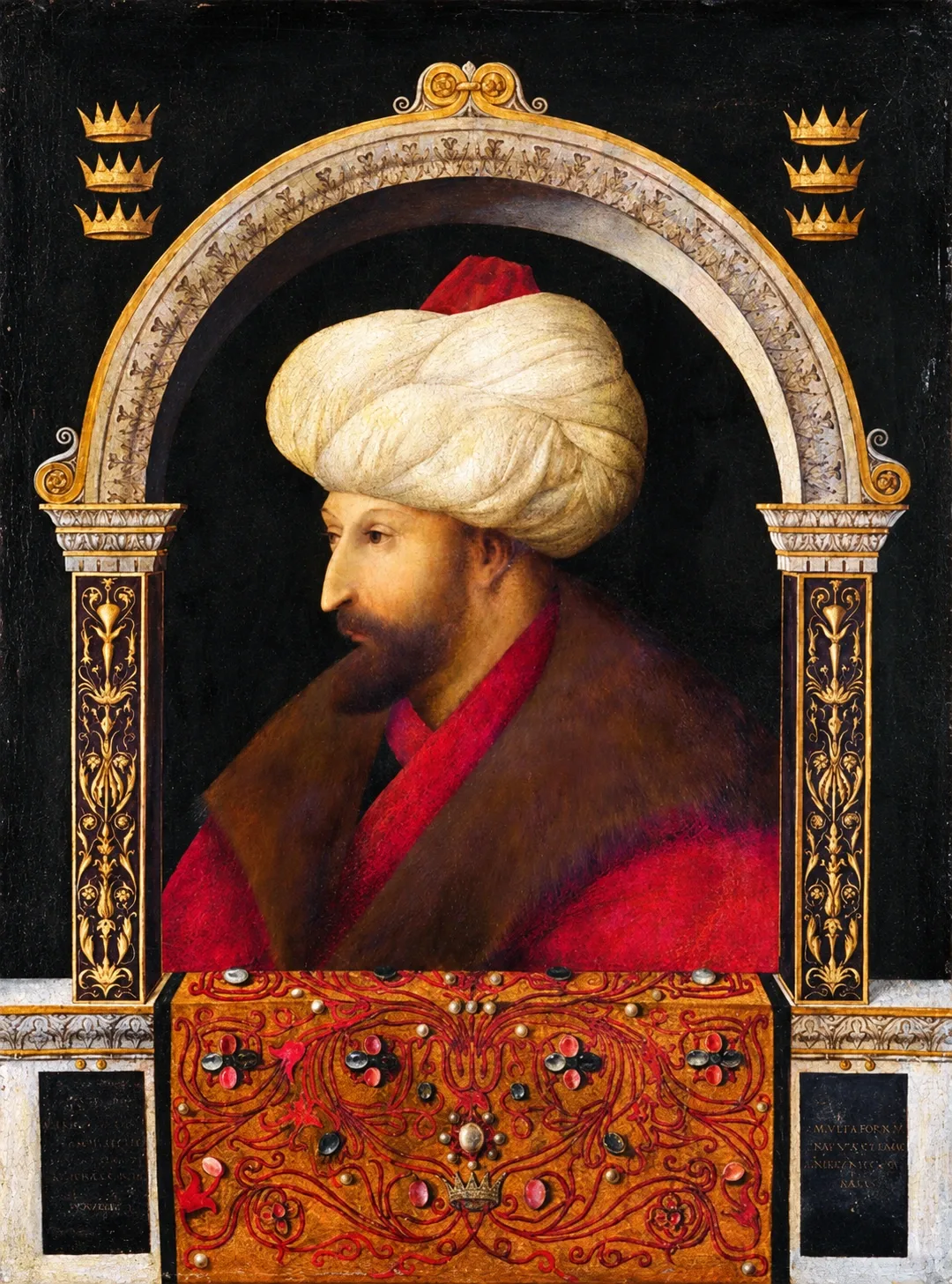
Portrait of Mehmed II the Conqueror by the Italian
Artist Gentile Bellini, 1480 CE
Gentile Bellini (c. 1429 – 23 February 1507) was a Venetian painter of the school of Venice. In 1479, he was sent to Constantinople by the Venetian government when Sultan Mehmed II requested an artist to spend some time in Constantinople as part of the peace settlement between Venice and the Turks. He painted the portrait of Mehmed II, now in the National Gallery, London.
4.4: Mehmed II: The Conqueror A Brief Biography (1432–1481 CE)
Mehmed II was one of the most influential leaders in world history. His reign transformed the Ottoman state from a regional principality into a global empire, bridging the Middle Ages and the Renaissance.
| Birth | March 30, 1432 CE, in Edirne (His father is Sultan Murad II) |
| Education | He mastered Turkish, Arabic, Persian, Greek, Latin, and Hebrew languages. |
| First Reign (1444–1446) | He was 12 years old when his father stepped down from the throne to him. However, due to internal instability and the threat of Crusades, his father went back to power, and Mehmed was sent to Manisa (city in Turkey’s Aegean Region) to continue his education and training. He joined his father’s campaigns as a commander and fought at the Second Battle of Kosovo (1448). This battle was his “final exam” in large-scale warfare. |
| 2nd Reign (1451-1481) | His father Murad II passed away in the year 1451. Mehmed was still in Manisa. At the age of 19, he was crowned Sultan for the second time. |
| Death | He died at the age of 49 while embarking on a new military campaign. He is buried at the Fatih Mosque complex which he constructed in the period (1463-1470). |
Mehmed II: Major Achievements
• The Conqueror: He successfully led many military
campaigns. He conquered Constantinople (1453), the capital of the Eastern Roman Empire. Then he conquered the Kingdom of Bosnia (1463) and asserted Ottoman dominance over the Crimean Khanate (1475).
• He codified the Ottoman law, centralizing power
under the Sultan and creating a formal administrative structure that lasted for centuries.
• He constructed the Fatih Mosque and complex
including a school, library, and hospital. It was the first imperial mosque in the Ottoman Sultanate.
• Topkapi Palace: He began construction of Topkapi
Palace which served as the primary residence and administrative headquarters of the Ottoman Sultans for nearly 400 years.
• The Grand Bazaar: He initiated the construction
of the Grand Bazaar (Çarşı-yı Kebir) the core of Istanbul’s legendary market.
• Preserved the Orthodox Church: After 1453,
Mehmed declared himself as (Caesar of Rome). He preserved the Greek Orthodox Church, and appointed Gennadius Scholarius as Patriarch. He gave the Church autonomy and protected the rights of the Greek population. In addition, he saved many Greek and Latin manuscripts from the Byzantine imperial libraries,
• Art and Culture: He invited Italian Renaissance
artists (like Gentile Bellini) and Greek scholars to his court, blending Eastern and Western cultures.
The world’s largest cannon was cast in Edirne in 1452 under the supervision of Urban, a Hungarian expert. The massive bronze bombard (Basilica) was capable of hurling stone projectiles weighing over 1,000 pounds against Constantinople´s outer walls.
Fatih Mosque (1463–1470 CE):
The first monumental imperial mosque complex built inside the city walls. Constructed on the fourth hill of Constantinople (the site of the former Church of the Holy Apostles), it was the first grand civic külliye— featuring extensive madrasas, a hospital, and a library.
The mosque you see today is actually a reconstruction. The original 1470 version was severely damaged by a massive earthquake in 1766. It was rebuilt and completed in its current form by 1771 under Sultan Mustafa III.
Editorial image noteFull-page photograph looking through a marble gateway toward an illuminated mosque courtyard and ablution fountain at night.
4.5: The Fatih Mosque and the Church of the Holy Apostles:
After he conquered the city, the Church of the Holy Apostles was initially left to the Greek Patriarch. However, it was in such bad condition that it was eventually demolished in 1461 CE.
The Sultan built the Fatih Mosque on top of the site where the Church of the Holy Apostles once stood. Construction on the complex began in 1463 CE, exactly ten years after the conquest of Constantinople. It took roughly seven years to finish that massive project, which was the first imperial mosque built in the city after the Ottoman takeover.
The passing away: He passed away in the year 1481 CE, and he was buried in his tomb in the mosque’s courtyard. The mosque wasn’t just a prayer hall; it was a külliye (a social complex). When it was finished, it included eight medreses (universities), a library, a hospital, a hospice, and a public kitchen.
Sultan Mehmed II tomb at Fatih Mosque
The Panorama 1453 History Museum (Panorama 1453 Tarih Müzesi)
It is an immersive attraction in Istanbul that pairs directly with the story of Hagia Sophia. Located near the historical Theodosian Walls in Topkapı Cultural Park, it is billed as the world›s first fully 3D panoramic museum.
Visitors stand beneath a massive 360-degree hemispherical dome painting (2,350 square meters) that recreates the morning of May 29, 1453—the precise moment Sultan Mehmed II (Al-Fatih) breached the Theodosian Walls.
www.panoramikmuze.com
Editorial image noteFull-page photograph looking up toward the central dome and suspended chandeliers of Hagia Sophia.
نهاية هذا القسم