دليل الجيب · A1 · الصفحات 121–149
هرقل ومحمد ﷺ
An encounter between empires and faith in the seventh century.
النص الإنجليزي الأصلي كاملًا. يعكس التعليق التاريخي والعقدي منظور الكتاب المصدر.
الفهرس والتنقّل
Appendices
Appendix 1: Heraclius and Muhammad
Appendix 2: Spotlight on Sultan Ahmed Mosque
Appendix-1 sheds the light on the letter sent by the Prophet of Islam Muhammad to the Roman Emperor Heraclius, which represents the first direct historical intersection between the Trinitarian Christian creed and the pure Unitarian Islamic creed. Appendix-2 sheds the light on the Blue Mosque facing Hagia Sophia and creating an interesting visual balance.
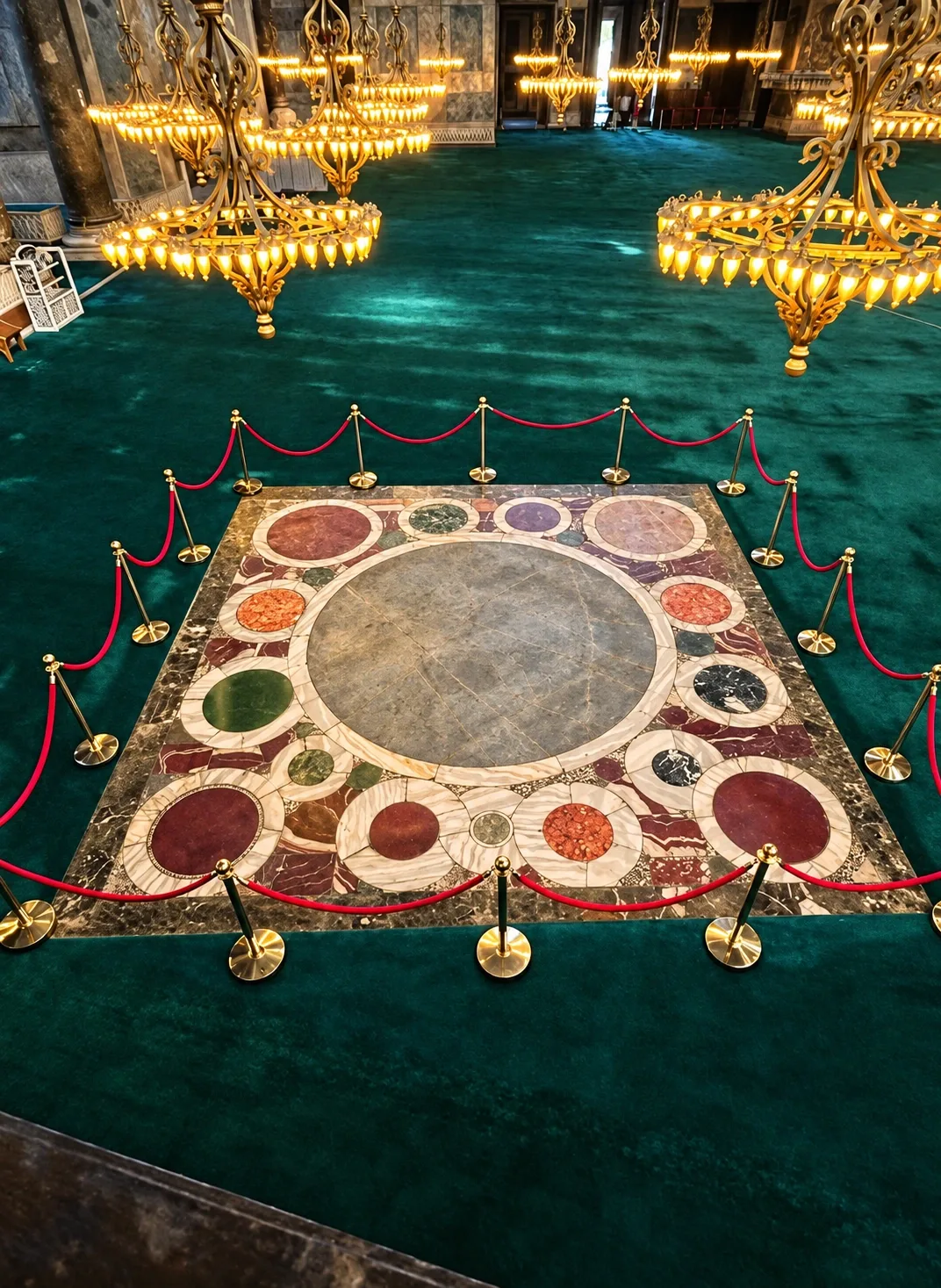
The Omphalion Navel of the Roman Empire
Located beneath Hagia Sophia’s massive dome, the Omphalion (Greek for “navel”) is a striking floor panel inlaid with concentric circles of colored marble. Representing the spiritual and political heart of the Byzantine Empire, it served as the ceremonial stage where emperors were crowned by the Patriarch of Constantinople as God’s anointed ruler.
Heraclius and Muhammad
The Dawn of Pure Monotheism
1- Heraclius, a Brief Biography
Heraclius was born around 575 CE in Cappadocia (Central Anatolia Türkiye). He is the son of Heraclius the Elder, the Roman governor of Africa. In 608 CE, he and his father launched a naval revolt (uprising) against the unpopular tyrant Emperor Phocas, sailing from Carthage (Tunisia) with a fleet to Constantinople. By October 610 CE, Heraclius entered Constantinople with local support, deposed Phocas, and was acclaimed emperor of Byzantium.
As the 20th ruler in the line of Constantine I, Heraclius’s reign marked a pivotal shift from the “Late Roman” to the “Byzantine” era, most notably through his decision to gradually replace Latin with Greek as the Empire’s official language.
Heraclius, crowned in Constantinople, 610 CE
Heraclius did not inherit the throne; he seized it by right of conquest. His coronation followed a powerful Roman Byzantine tradition: The Patriarch of Constantinople crowned him as a divinely sanctioned ruler, underscoring the legitimacy of his reign. He would rule for over three decades, from 610 to 641 CE.
Heraclius presided over solemn ceremonies and blessings within Hagia Sophia following his victory over the Sasanian Empire, where he restored the True Cross to Christendom.
The Roman Empire at the time of Heraclius
When Heraclius was crowned, the geography of the Roman Byzantine Empire looked like this:
• The Core: Anatolia (modern Turkiye), Greece, and
the Balkans.
• Egypt: The Breadbasket (provided grains to feed
Constantinople).
• The Levant: Syria, Palestine, and Jordan (Arabia
Petraea).
• The Western Remnants: North Africa (Carthage—
where Heraclius came from), Sicily, and small coastal
strips of Italy (including Rome and Ravenna).
www.livescience.com
The Great War with the Persians (602 – 628 CE)
The Sassanid Persian King, Khosrow II, had conquered the Roman Levant, Egypt, and Jerusalem. The Persians under King Khosrow II, captured Jerusalem in May 614 CE after a brutal 21-day siege.
They captured the True Cross (the holiest relic in Christendom) from Jerusalem and brought it to their capital, Ctesiphon. (The Persian General Shahrbaraz entered the city, burned the Church of the
Holy Sepulcher, and seized the True Cross).
Heraclius invades Azerbaijan (624 CE): Heraclius lead a multi-year campaign to restore the lands they lost as well as the True Cross. In 624 CE, Heraclius invaded the Persian heartland (Azerbaijan) and destroyed the Great Fire Temple of Ganzak (the most sacred site for the Persians). This was the psychological “moment of victory”.
Battle of Nineveh 627 CE: Heraclius personally led his army to fight the Persians which ended with a great victory to the Romans.
The Peace Treaty (628 CE): The Persian Empire collapsed into civil war, the King (Khosrow II) was killed by his own son, and the Persians finally agreed to return the True Cross.
Heraclius returned the True Cross to Jerusalem after 16 years of capture. In March 630 CE, he personally carried the Cross back to Jerusalem.
2-The Prophet of Islam Muhammad, a Brief Biography
Muhammad was born in Makkah (Mecca) in 570 CE, during the reign of the Roman Emperor Justin II. Long before his prophethood, he was renowned throughout the Arabian Peninsula for his exceptional character. In a society built on the pillars of tribal honor and commerce, a man’s reputation served as his most valuable currency. Among his people, he was honored with two distinct titles: Al-Sadiq (The Truth-Teller) and Al-Amin (The Trustworthy).
In his early years, Muhammad led a life of quiet integrity, unaware of the destiny that awaited him. He married Khadijah, a noblewoman of Makkah, with whom he had six children—four daughters and two sons who passed away in their childhood. His marriage lasted for about 25 years until his wife Khadijah passed away in the year 619 CE.
Even in a polytheistic society where idol worship was rife, Muhammad never bowed to stone; he believed that one single, Supreme Creator governed the universe.
Seeking clarity, he often retreated to a cave on a mountain four kilometers east of Mecca. It was here, in 610 CE, that his life—and the course of history—changed forever. At the age of forty, while deep in meditation, the Archangel Gabriel appeared to him for the first time with a single, command: “Read!”
“Read in the Name of your Lord Who created (everything), He created man from a clot. Read! and your Lord is the All-Munificent Who taught man by the pen He taught man what he didn’t know!
The Quran 96:1
These few verses marked the beginning of the Quran, the final divine scripture for humanity, which would be revealed over a period of twenty-three years until Prophet Muhammad passed away in 632 CE.
Prophet Muhammad remained in Makkah for thirteen years, calling first his inner circle and then the public to the worship of the One Creator and the abolition of idolatry.
It was during this period of intense persecution that a specific chapter of the Quran was revealed: Surat Al-Room (The Romans). At a time when the Byzantine Empire seemed on the verge of total collapse, these verses offered a startling prophecy: despite their current defeat, the Romans would emerge victorious over the Persians within a few years.
In the name of Allah,
the Entirely Merciful, the Especially Merciful. The Romans have been defeated in the nearest
(lowest) land. But they, after their defeat, will
overcome (be victorious) within a few years.
To Allah belongs the command before and after.
And that day, the believers will rejoice in the victory
of Allah. He Gives victory to whom He Wills, and He
is the Exalted in Might, the Merciful.
The Quran 30:2-5
Migration to Madinah (622 CE)
In 622 CE, the Prophet migrated to Madinah (Medina), marking a new era for the Islamic mission. History then produced a remarkable alignment in 624 CE, the year Heraclius launched his successful counter-offensive into the Persian heartland, the Muslims achieved their first major victory at the Battle of Badr. Just as the Quran had foretold, “the believers rejoiced” on that time, celebrating a double victory for the believers in God over paganism.
Photo from Madinah, Prophet Muhammad Mosque
A ten-year truce:
Four years later, in 628 CE, a ten-year truce known as the Treaty of Hudaybiya was signed between the Muslims and the Meccan leadership. This pause in domestic conflict opened a window for international diplomacy. Seizing this period of peace, the Prophet dispatched letters to the great monarchs of the age, most notably Heraclius of Byzantium and Khosrow II of Persia.
Sassanian Emperor of Persia (Khosrow II) Roman Emperor (Heraclius)
Mukaukis of Egypt Medina (Madinah)
king of Abyssinia (Negus)
Ruler of Bahrain Rulers of Oman
www.nationalgeographic.com
Muhammad’s Letter to Heraclius
The letter to Heraclius remains a masterpiece of seventh-century diplomacy. Carried by the companion Dihya al-Kalbi and delivered through the Governor of Busra, the document was a model of statecraft: concise, firm, and meticulously observant of imperial protocols.
In the name of Allah, the Beneficent, the Merciful
From: Muhammad, The servant of Allah and His Messenger, To: Heraclius, the Great (Leader) of the Romans.
Peace be upon him who follows the right path. Furthermore, I invite you to Islam (submit to One God Allah the Creator of the Universe and all beings) and worship Him alone. Accept Islam and you will be in state of safety; accept Islam and Allah will double your reward. But if you turn away, you will bear the sin of “Arisiyyin” (your subjects: Arians)
‘O People of the Scripture! Come to a word that is just between us and you: that we worship none but Allah, and that we associate no partners with Him, and that none of us shall take others as lords besides Allah. Then, if they turn away, say: Bear witness that we are Muslims.
(The Quran 3:64)
Heraclius’s Testimony:
The Emperor’s Inquiry into Prophet Muhammad When Heraclius, received Muhammad's letter, he was in the Levant region (most likely in Jerusalem), so he invited Abu-Sufyan (one of the main chiefs and tradesmen of Makkah who was by chance doing business in the Levant region) to attend him. Heraclius asked Abu-Sufyan a few questions and requested that he be honest.
| Heraclius | Which social class of the society does Muhammad come from? |
Abu-Sufyan He comes from a noble family in Mecca.
| Heraclius | Did he ever betray, break a promise, or lie? |
Abu-Sufyan No
| Heraclius | How about his followers, are they increasing or decreasing? And have any of his followers quit because they were not pleased with Muhammad? |
Abu-Sufyan In fact, his followers admire him and they are increasing in number.
| Heraclius | Then what does Muhammad teach his followers? |
Abu-Sufyan Belief in One God and social justice.
| Heraclius | Heraclius made a statement that shocked his generals and the nobles standing in the room: |
“If what you say is true, he will soon conquer the ground beneath my very feet. I knew (from the Scriptures) that he was going to emerge, but I did not think he would be from among you. If I knew I could reach him, I would have endured any hardship to meet him; and if I were with him, I would surely
wash his feet”. Narrated by Bukhari and Muslim
Heraclius Judging Muhammad
Heraclius did not judge the Prophet by miracles; he could present, but he judged him by character. He used his Roman logic to realize that a man who never lied to any one, would not lie about The Creator of the Universe and all beings. In that moment, the Emperor saw the future; he realized his empire’s walls could stop armies, but they could not stop the “sweetness of faith”.
It is a stunning historical coincidence that Muhammad received the first divine revelation in the very same year that Heraclius was crowned Emperor in Constantinople (610 CE).
3 - The Passing Away of Muhammad
The Spread of Islam (the unstoppable message of monotheism)
In 632 CE, Prophet Muhammad passed away in Madinah, having unified the Arabian Peninsula under the banner of Tawhid (the Oneness of God).
To many outside observers, his departure should have signaled the end of the Islamic movement; historically, the death of a charismatic leader often leads to the collapse of his cause. However, this sacred mission did not falter. Driven by a profound passion and an unshakable faith, the early Muslims did not believe they were fighting for a man, but for a Divine Message—a call to return all of humanity to the worship of the One Creator.
The Battle of Yarmouk, 636 CE
Under the leadership of the first Caliphs, the Islamic progress continued with an energy that baffled the Roman generals. It was this spiritual momentum that led to the final clashes between the two realms, most notably at the Battle of Yarmouk in 636 CE. While the Romans fought for an aging empire and a complex state theology, the Muslims fought with the conviction of a people carrying a final scripture to the world.
During the decisive battles for Syria, Heraclius was stationed in Antioch, directing the war effort. He witnessed his veteran legions shatter before the tactical genius of the Muslim military commander Khalid ibn al-Walid.
The Peaceful Takeover of Jerusalem, Heraclius departs the Levent
Knowing Jerusalem would soon fall, Emperor Heraclius moved the True Cross to Constantinople to protect it. It was displayed in the Hagia Sophia cathedral during major events until crusaders looted the city in 1204 CE.
As Jerusalem was peacefully surrendered to Caliph Umar ibn al-Khattab in 638 CE, Heraclius retreated across the mountains, leaving the province forever. Turning back to gaze upon the land he had spent nearly two decades reclaiming from the Persians, he whispered a final, heartbreaking farewell (according to some historical resources):
“Peace be with you, O Syria!
What a beautiful land this is for the enemy.”
The Muslims brought with them a new world order. The Roman retreat was not merely a military withdrawal; it marked the end of an ancient imperial era and the beginning of a transformation that would permanently redefine the region´s religious and political geography.
4 - Heraclius: Personal Life and Final Years
His personal life was as dramatic and controversial as his political one. His family life caused a massive scandal that some believe “cursed” his reign.
His first wife died in 612 CE: He was married
to Fabia Eudokia who was crowned alongside him in 610 CE but tragically died just two years later (612 CE) from epilepsy. She gave him a son, Heraclius Constantine (the heir), and a daughter.
Married to His Niece?
About a year after his first wife died, Heraclius did something that shocked the Christian world: he married his niece, Martina. In the eyes of the Church and the Roman people, this was incest. The Patriarch of Constantinople refused to support it, but eventually gave in and crowned her. Martina was hated by the public. When many of her children were born with disabilities or died young, the people of Constantinople whispered that it was a curse and “divine punishment” for the incestuous marriage.
The Passing Away of Heraclius
Heraclius’s death was a shadow of his glorious youth. He died on 11th February, 641 CE (about 9 years after the passing away of Prophet Muhammad). He suffered from a terrible condition called dropsy (edema) and complications with his urinary tract. Contemporary chroniclers claimed his body was “rotting” as a punishment for his marriage to his niece.
He died at the age of 66, leaving behind a complex legacy of a man who saved the Empire from one enemy only to witness the rise of another. He left an empire that was smaller in size, yet profoundly transformed into the Greek-speaking, medieval Byzantine state that would endure for another 800 years.
During the Fourth Crusade, the Crusaders attacked Constantinople, and broke into the imperial tombs in the Church of the Holy Apostles. They stripped gold and jewels from the stone coffins. Because of this, it is very likely that Heraclius’s tomb was robbed and his resting place was ruined.
The Burrial of Heraclius
Heraclius was buried in the most prestigious location in the Byzantine world: The Church of the Holy Apostles in Constantinople. At the time, the Church was the second most important one after the Hagia Sophia. It served as the imperial mausoleum where almost all Roman/ Byzantine emperors were laid to rest, starting with Constantine the Great.
There are four Imperial sarcophagi (a stone coffin, adorned with sculpture or inscriptions) -called larnax in Greek -in front of the Archaeological Museum in Istanbul. They came from the Church of the Holy Apostles.
Fatih Mosque in Istanbul is built on the site of the Byzantine Church of the Holy Apostles. It served as the burial site for many Roman emperors, including Constantine the Great and Heraclius. The church had fallen into a severe state of disrepair before it was demolished in 1462 CE.
Feature Stories
Foretold and Fulfilled: Two Predictions that Reshaped History
1-The Story of Suraqah; A promise fulfilled 20 years later
When Prophet Muhammad migrated to Medina with his close companion Abu Bakr (622 CE), the Meccan leaders announced a large reward of 100 camels for anyone who could bring Muhammad dead or alive.
Unfortunately, Muhammad and his companion were tracked down by one of the Arab knights named Suraqah bin Malik who was tempted by the big reward. On the way, his horse stumbled and he fell on the ground a few times. He considered these unusual incidents as an indirect message that Muhammad probably had been supported by divine power.
When Suraqah approached Muhammad Prophet, Muhammad said to him: “Do return to your people
and I promise you that one day (under the umbrella of the Islamic state) you would wear the bangles (bracelets) of Chosroes (Khusrow), the Persian ruler."
Suraqah asked in wonderment if Prophet Muhammad meant the bangles of Khusrow bin Hormuz, the emperor of Persia. Prophet Muhammad replied "yes" with full confidence. He had a strong faith that the religion of Islam would reach Persia and would be known all over the world.
Suraqah returned back to Mecca (Makkah) but he didn't embrace Islam until Muhammad took over Mecca peacefully in 630 CE (8 years later).
Prophet Muhammad passed away in the year 632 -633 CE but his story with Suraqah was known to his companions who had strong faith that the Prophet’s promise would be fulfilled one day.
Time passed until Omar Bin Al-Khattab became the second caliph (ruler of the Muslim state). At his time, Islam reached Persia in the year 642 CE and all the treasures of Khusrow, the emperor of Persia fell in the hands of Omar.
Omar remembered the story of Suraqah and asked his companions to bring him in. Twenty years passed since this story took place and Suraqah had become an old man.
After prayer congregation, Omar said to Suraqah: “Here are the bangles of Khusrow, the emperor of Persia, this is what Muhammad had promised you. Put them on and let all Muslims see them so everyone becomes certain that Muhammad’s promise is fulfilled.”
Suraqah cried and every one wept. Prophet Muhammad’s promise became a reality 10 years after he passed away.
2-The Story of Heraclius Prediction: How it Unfolded after the Prophet’s Passing Away
Around the same era, Byzantine Emperor Heraclius sat at the pinnacle of global power. Having just defeated the Sasanian Persians (628 CE) in a devastating decades-long war, he received a letter sent by Prophet Muhammad calling him to Islam, alongside reports of a new monotheistic movement emerging from the Arabian Peninsula. Intrigued, Heraclius summoned Arab merchants trading in the Levant—including Abu Sufyan, a leading chieftain of pagan Mecca and a fierce opponent of the Prophet.
Heraclius questioned Abu Sufyan intently about the Prophet’s lineage, character, message, and followers.
Abu Sufyan admitted that Muhammad was nobleman of impeccable honesty, preached strict monotheism (Tawhid), commanded social justice, and that his followers never abandoned his faith.
Upon hearing this, Heraclius recognized the scriptural patterns of historical prophethood and made his famous declaration:
“If what you say is true, he will soon conquer the ground beneath my very feet.”
Heraclius’s prediction unfolded across the Levant. Following the decisive Battle of Yarmouk in 636 CE, Byzantine control over Syria, Palestine, and Egypt permanently dissolved. In 637–638 CE, Jerusalem surrendered peacefully to Caliph Umar.
Heraclius passed away on February 11, 641 CE in Constantinople as a broken leader, having watched the southern half of his empire—including the Levant, Palestine, and Egypt—slip permanently from Byzantine control during his final years.
Note: The Muslims won the Battle of Nahavand in 642 CE, which broke the last organized Sasanian army shortly after Emperor Heraclius’s death and marked the decisive fall of the Persian Empire.
Standing before the Omphalion—the marble floor inlay where Byzantine sovereigns, including Emperor Heraclius, were once crowned—one is struck by a profound convergence of history and prophecy.
Looking up from the very ground where Roman emperors asserted their imperial might, the eye is drawn to the majestic calligraphic medallion bearing the name MUHAMMAD ﷺ towering high above the nave.
Centuries after Heraclius foresaw that the message of Islam would reach the land beneath his feet, Constantinople was transformed, Hagia Sophia was consecrated as an imperial mosque, and the name of the Prophet was elevated over the ancient coronation spot—a visual testament to the shifting tides of empire and faith.
Hagia Sophia’s evolution from an imperial cathedral into a celebrated mosque stands as a visual reflection of Heraclius’s own ancient insight: that the message brought by the Prophet would one day echo across the great historical capitals of the world. At its heart, this journey reflects the enduring triumph of pure monotheism—the singular, timeless truth carried by all prophets throughout history to unite humanity in the worship of the One True God.
This source page contains an illustration with no body text.
نهاية هذا القسم