دليل الجيب · 08 · الصفحات 111–120
عودة عيسى عليه السلام
An epilogue exploring the Islamic perspective on peace and monotheism.
النص الإنجليزي الأصلي كاملًا. يعكس التعليق التاريخي والعقدي منظور الكتاب المصدر.
الفهرس والتنقّل
Epilogue:
Return of Jesus, A Promise of Peace & Monotheism
8.1 Introduction
In the Islamic tradition, Jesus (Isa ibn Maryam) occupies a position of profound reverence. The Quran describes him as “God’s Word” and “glad tidings” bestowed upon Mary, explicitly honoring him as the Messiah (the blessed and purified).
Supported by the Holy Spirit, Jesus was sent as an illustrious messenger of Allah to the Children of Israel, tasked with guiding them toward the absolute unity of God (Tawhid) and away from theological deviations.
Note: Photo on the left is for Umayyad Mosque in Damascus. Prophet Muhammad indicated that Jesus will return and he will descend from the heavens first in Damascus.
He was granted divine wisdom, the mastery of both the Torah and the Gospel, and the power to perform monumental miracles—healing the blind, curing the leper, and raising the dead by Allah’s leave.
Far from being a figure related to the past, Jesus remains central to Islamic faith which dictates that the Day of Resurrection will not occur until Jesus descends from the heavens to the earthly realm.
Muslims believe in Jesus return: According to prophetic narrations (Hadith), his descent will take place at the white minaret on the eastern side of Damascus, Syria.
Returning as a just ruler before the end of the world, Jesus the Messiah will dismantle falsehood, defeat the false messiah (Al-Masih ad-Dajjal), and unite all true believers under the banner of pure monotheism, establishing universal peace and divine law on Earth.
Jesus
He is one of Arch-Prophets of Determination: Within Islamic theology, Jesus is recognized as one of the Ulul-Azm—an Arabic honorific meaning “The Messengers of Firm Resolve” or “Arch-Prophets of Determination”. This elite title is reserved for only five prophets who bore the heaviest burdens of revelation and exhibited unmatched steadfastness in the face of extreme persecution: Noah, Abraham, Moses, Jesus and Muhammad.
By placing Jesus within this ultimate spiritual rank, Islamic doctrine elevates his mission alongside the foundational lawgivers of human history, framing his return not as a secondary event, but as the ultimate fulfillment of God’s Will and plan.
Jesus said:
“I have not come to abolish the Law or the Prophets; I have not come to abolish them but to fulfill them”. Matthew 5:17
Jesus Return
A moment of ultimate clarity for all humanity
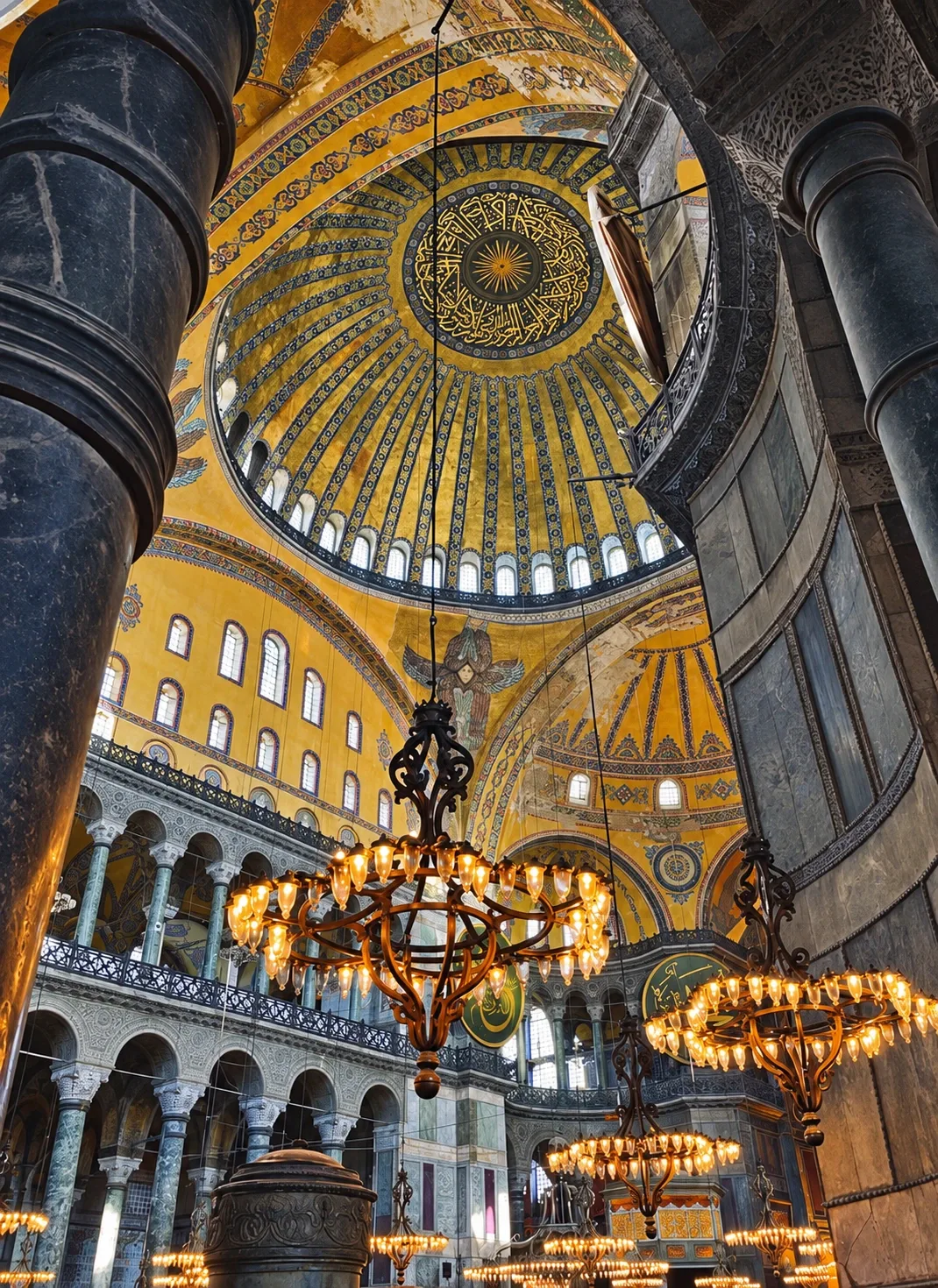
The narrative of Hagia Sophia does not end in the past; it points toward a shared future and extends beyond its complex architectural history. Both Christian and Muslim traditions look forward to the return of Jesus (Isa, peace be upon him), a moment of ultimate clarity for all humanity.
In this shared prophecy, he returns not as a figure of division, but as a restorer of the primordial (early) Message: the worship of the One True God, our Creator, “Allah” the Creator of the Universe and all beings.
Islamic scholarship emphasizes that Jesus’s original mission was centered on absolute devotion to the Creator, pointing to Gospel accounts such as Mark 12:29 where Jesus affirms the Shema (Hear, O Israel: The Lord our God, the Lord is one) as reflecting this original monotheistic calling. The historical record of Jesus’s life reinforces this mission. He never invited humanity to worship him; rather, he was a humble servant who directed all praise to Allah (the Father in Christianity).
“The most important one, answered Jesus, is this: Hear, O Israel: The Lord our God, the Lord is one.”
Mark 12:29
“By myself I can do nothing; I judge only as I hear, and my judgment is just, for I seek not to please myself but him who sent me.”
John 5:30
Jesus said, “...Go instead to my brothers and tell them, ‘I am ascending to my Father and your Father, to my God and your God.”
John 20:17
This strong emphasis on the singular God was deeply ingrained in the minds of the first Christians since early Christianity emerged from Judaism, which is strictly monotheistic.
On the other hand, Islam teaches that all true prophets and messengers have submitted to their Lord, Allah the Almighty, the Glorified and Exalted.
In the Quran, chapter 20:14 (Surah Taha), when God spoke to Moses for the first time, He said:
“Indeed, I am Allah. There is no deity except Me, so worship Me and establish prayer for My remembrance”.
Say, He is Allah, (who is) One (indivisible). Allah, the Eternal Refuge (The Self-Sufficient Master). He neither begets nor is born, nor is there to Him any equivalent.
The Quran, 112:1-4
From a Muslim perspective, the “Divine Wisdom” of Hagia Sophia resonates with these verses from the Holy Quran.
8.2 Jesus’s Return and Hagia Sophia
When Jesus returns, let us imagine that he will visit Hagia Sophia, walk beneath its dome and see the Christian and Islamic traditions entwined. Finding it a mosque where the Oneness of God is proclaimed five times a day, he would see a reflection to what he preached in the hills of Galilee in Palestine and an echo of his own core message.
Under his leadership, Hagia Sophia will stand no longer as a prize of conquest or a site of debate, but as a global beacon of monotheism, peace and prosperity.
The stones of Hagia Sophia have witnessed more than the rise and fall of empires; they have stood as a silent theater for a fundamental debate in human history: the nature of God.
The transition of Hagia Sophia into a mosque in 1453 CE was the architectural manifestation of this theological return transforming the grand dome into a canopy for Tawhid (Oneness of God). Today, as the five daily prayers echo through the building of Hagia Sophia providing a clear witness to the absolute unity of Allah (The
Creator of the Universe and All Beings).
Hagia Sophia’s journey is a living symbol of humanity’s enduring quest for the Truth. It stands as a monumental reminder that despite centuries of disagreement, there has always been a voice of Wisdom calling humanity to recognize the Oneness of God.
Oneness of God was preserved through the ages, since Adam, Noah, Abraham, Jacob, Moses, Joseph, Jesus and Muhammad times and will eventually unite all believers under the banner of peace and the worship of the One.
Hagia Sophia
Text equivalent of the source flowchart:
Arianism (nontrinitarian) → Trinity → Monotheism → Oneness of God.
Church-1 (Arian) → Church-2 (Trinitarian) → Cathedral (Trinitarian) → Mosque (Unitarian) → Museum → Mosque.
نهاية هذا القسم