دليل الجيب · 00 · الصفحات 1–12
عند ملتقى عالمين
Introduction, origins of the name, and a visual overview of the centuries.
النص الإنجليزي الأصلي كاملًا. يعكس التعليق التاريخي والعقدي منظور الكتاب المصدر.
الفهرس والتنقّل
HAGIA SOPHIA — Pocket Guide
From Trinity to Pure Oneness of God
Understanding The Islamic Perspective
First Edition, 2026
Osoul Center — www.osoulcenter.com
HAGIA SOPHIA
Published by: Ossoul Center, KSA
Copyright © Ossoul, 2026 All rights reserved. No part of this publication may be reproduced or transmitted in any form or by any means without a written permission from the author or the publisher.
Book and cover design: Taylor & Toglaw
Printed and bound in Kuwait by KHAT Press
Feedback and inquiries:
info@kim.org.tr
C&D: Live chat, 24/7
First Edition, October, 2026
Brief Contents
| Introduction | 4 |
| Chapter 1: The Roman Empire: From Foundation to Fall | 13 |
| Chapter 2: Hagia Sophia: The Early Churches — Arianism → Trinitarianism | 29 |
| Chapter 3: Hagia Sophia: The Latin Schism — Orthodoxy → Catholicism → Orthodoxy | 43 |
| Chapter 4: Hagia Sophia: The Great Transition — Cathedral → Mosque | 51 |
| Chapter 5: Hagia Sophia: The Final Synthesis — Mosque → Museum → Mosque | 73 |
| Chapter 6: Understanding the Islamic Creed | 91 |
| Chapter 7: Divine Messages — From the Lord of People to All People; Excerpts from the Holy Quran | 101 |
| Chapter 8: Epilogue: Return of Jesus — A Promise of Peace & Pure Monotheism | 111 |
| Appendix 1: Heraclius and Muhammad | 123 |
| Appendix 2: Hagia Sophia and the Blue Mosque | 151 |
| References | 156 |
Introduction
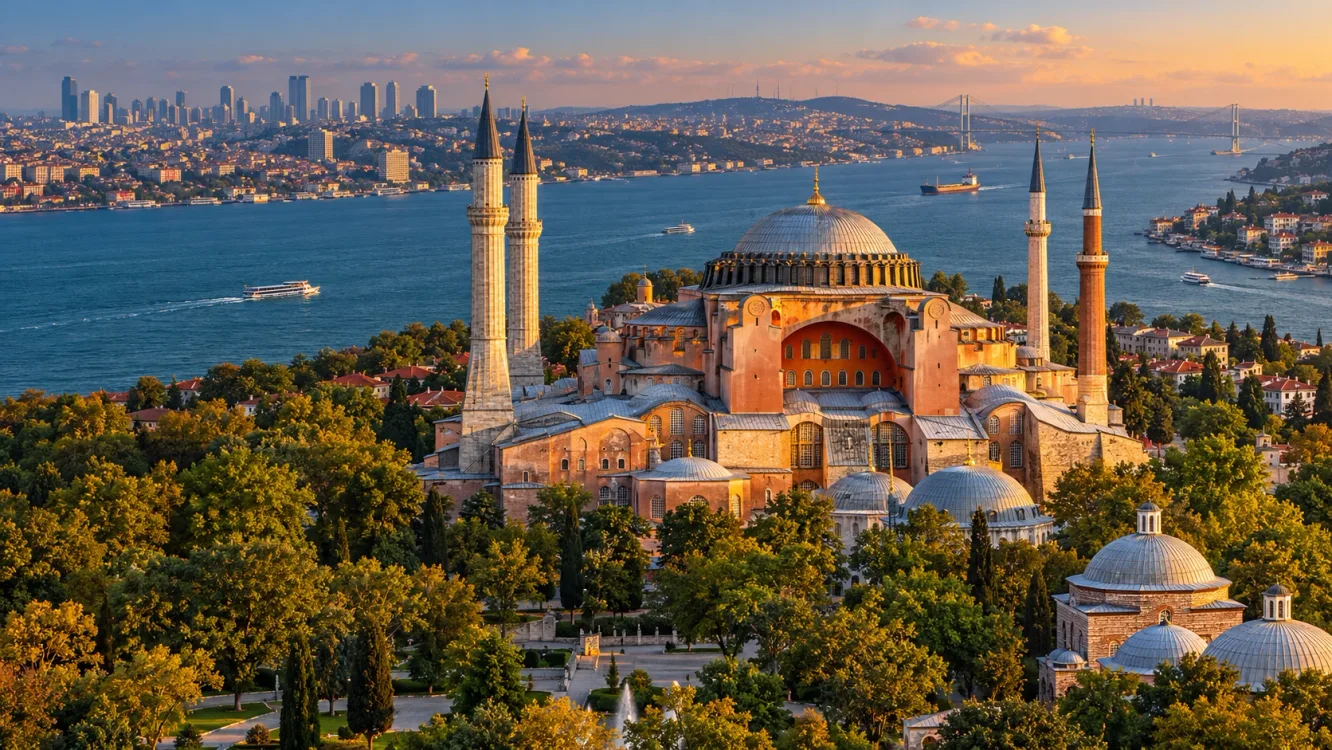
Standing at the threshold of East and West, Hagia Sophia has sheltered the prayers of two worlds and embraced the spirits of Christianity and Islam under a single dome.
To understand why Hagia Sophia exists, we must first look at the Roman Empire—not at its height of pagan glory, but during its radical transformation into a Christian state. At the heart of this era was a fierce struggle over the nature of the Divine. We explore the era of Arianism and the early non-Trinitarian debates, examining how the doctrine of the Trinity was eventually codified across the Empire. This sets the stage for the arrival of the Ottomans, who returned Hagia Sophia to a strictly monotheistic worship.
Today, Hagia Sophia remains a vivid and vital sanctuary. The cadence of the five daily prayers— before the first light of the sunrise to the evening stillness after the sunset—keeps the space in a state of constant devotion, and fully occupied by the remembrance of our Lord.
To grasp this living legacy, we explain the fundamental differences between Christian and
Islamic creeds. In addition, we explore how trinity was introduced to Christianity after the ascension of Jesus to the heavens. Ultimately, we look toward a shared horizon: The return of Jesus as a prophet and a messenger of God who will unite both faiths and all believers in God under the banner of monotheism. He will bring humanity to submit to One and Only One indivisible God, Allah the Creator and Lord of all beings.
Osoul Center
DEDICATION
To those in search of "The One" The Unique, the Peerless, the Eternal.
We dedicate this work to every visitor of Hagia Sophia who seeks to explore its history from before the birth of Jesus until the present day, as we look forward to the return of the Messiah, Jesus son of Mary, to unite all believers in God upon pure Monotheism.
HAGIA SOPHIA — The Divine Wisdom
"Hagia" is a Greek word meaning holy or sacred. It is the feminine form of the Greek adjective hagios (holy or saint) and is most commonly used in the context of Hagia Sophia which translates to "Holy Wisdom". This is similar to other feminine nouns, such as Hagia Irene (Holy Peace).
In Greek, sophía (σοφία) literally means wisdom. The Holy Wisdom was considered a specific attribute of God.
This is not to be confused with Saint Sophia in Christian history (a widow who had three daughters). While many other churches are dedicated to her, the Great Church in Istanbul was specifically dedicated to the Divine Wisdom.
Note:
- The Statue of Liberty isn’t dedicated to a woman named Liberty; its dedicated to the concept of freedom.
- The Turkish name of Hagia Sophia is Ayasofya.
The Roman Empire: Rise to Fall
753 BCE — The Roman Kingdom was established in Rome.
27 BCE — It became a Roman Empire.
1 CE — Jesus was born.
Due to a calculation error when the AD calendar system was created in the 6th century, Jesus was actually born c. 6–4 BCE rather than 1 CE.
Summarized Visual Timeline
2205 years
395 CE — Split of the Roman Empire to Western part (predominantly Latin-speaking) and Eastern part (predominantly Greek-speaking).
476 CE — The fall of the Western Roman Empire (capital was Rome then Milan then Ravenna in modern day Italy).
570 CE — Muhammad was born (570 CE).
In the year 628–629 CE approx. Prophet Muhammad sent a letter to Heraclius, the Roman Emperor inviting him to Islam (pure monotheism).
1453 CE — The fall of the Eastern Roman Empire (capital was Constantinople).
Historical Transformations of Hagia Sophia
Constantine I (The Great): 306–337 CE. He moved the capital from Rome to the strategic city of Byzantium. Renamed Constantinople (330 CE).
| 360–404 CE | Constantius II | First Church — The Great Church (burned in 404 CE) |
| 415–532 CE | Theodosius II | Second Church — Publically called Hagia Sophia (burned in 532 CE) |
| 537–1453 CE | Justinian I | Masterpiece — Hagia Sophia. The building we see today (since 537 CE). Orthodox → Catholic → Orthodox |
| 1453–1935 CE | Sultan Mehmed II, The Conqueror | Ayasofya Grand Mosque |
A museum for 85 years.
A Mosque as from 2020 — until Now.
Hagia Sophia: Mirror of Empires
How the Rise and Fall of Empires Reshaped a House of Worship
| Year CE | Political Changes | Status of Hagia Sophia |
|---|---|---|
| 476 | The fall of the Western Roman Empire The rise of the Eastern Roman Empire (Byzantine) | Church (537) |
| 1453 | The fall of the Byzantine Empire The rise of the Ottoman Empire (Sultanate) | Mosque (1453) |
| 1918 | The fall of the Ottoman Sultanate The rise of the Republic of Turkey (the Caliphate was abolished in 1924) | Museum (1935) |
| 1923 Until Now | The Republic of Turkey (Founded October 29, 1923) | Mosque (2020) |
Editorial image noteFull-page photograph of the interior of the Colosseum in Rome.
نهاية هذا القسم