دليل الجيب · A2 · الصفحات 150–155
حكاية معلمين
Hagia Sophia and the Blue Mosque: an architectural dialogue across centuries.
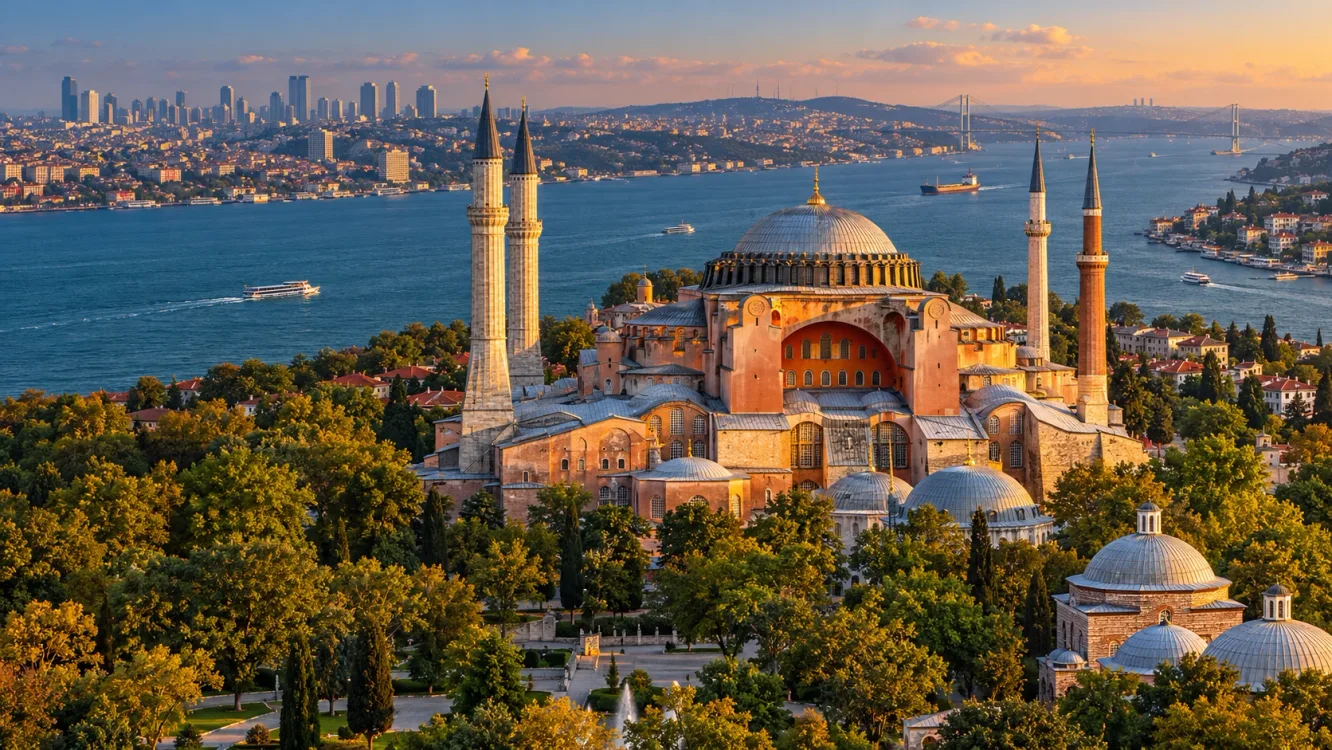
النص الإنجليزي الأصلي كاملًا. يعكس التعليق التاريخي والعقدي منظور الكتاب المصدر.
الفهرس والتنقّل
163 years after the conquest in 1453 CE
Standing directly across Sultanahmet Square, the Sultan Ahmed Mosque (famously known as the Blue Mosque) was positioned in 1609 to engage in an architectural dialogue with Hagia Sophia. Young Sultan Ahmed I explicitly chose the site of the ancient Byzantine Great Palace—with a bold vision: to build an imperial Islamic sanctuary that could match and visually balance the grand scale of Justinian’s 6th-century masterpiece.
Though separated by nearly 1,080 years of history, the two iconic monuments stand face-to-face as sister peaks on the Istanbul skyline—one embodying Byzantine-Christian heritage transformed by Islam, and the other representing the absolute pinnacle of classical Ottoman architecture.
Appendix 2
Hagia Sophia and the Blue Mosque:
A Tale of Two Landmarks and a Dialogue Across Centuries:
The Blue Mosque (1609 - 1616)
The Blue Mosque (officially the Sultan Ahmed Mosque) was built between 1609 and 1616 CE. (163 years after the conquest in 1453 CE)
While Hagia Sophia uses its 40 windows to create a “mystical” gloom, the Blue Mosque uses over 200 stained-glass windows and thousands of blue tiles to create a bright interior (over 20,000 handmade iznik tiles).
The Dome: The Blue Mosque’s dome is slightly smaller than Hagia Sophia’s, but because it sits on a series of “cascading” smaller domes, it looks more symmetrical and balanced from the outside.
Massive “Elephant Foot” Columns: The colossal central dome (23.5 meters in diameter) and four semi-domes are supported by four huge fluted marble piers—popularly known as “elephant feet”—each measuring 5 meters in diameter.
Sultans and Notable Mosques
| Mehmed II The Conqueror | Eyüp Mosque It marks the discovery of the tomb of Abu Ayyub al-Ansari (companion of Prophet Muhammad ) Rebuilt: 1798–1800 | 1458 |
| Mehmed II The Conqueror | Fatih Mosque Mehmed II built the first minaret of Hagia Sophia (red brick) in 1453 | 1470 Rebuilt (1771) |
| Bayezid II | Bayezid II Mosque Bayezid II built the 2nd minaret of Hagia Sophia (white limestone) | 1506 |
| Suleiman I The Magnificent (Lawgiver-Kanuni) | Süleymaniye Mosque | 1557 |
| Selim II | Selimiye Mosque (Selim II Commissioned the 3rd and 4th minarets of Hagia Sophia (designed by Mimar Sinan), completed during Murad III reign (1570). | 1575 |
| Ahmed I | Blue Mosque Sultan Ahmed Mosque | 1616 |
| Selim III | Eyup Sultan Mosque (rebuilt) | 1798–1800 |
| Abdulmejid I | Ortaköy Mosque | 1854 |
| Abdulhamid II | Yıldız Hamidiye Mosque | 1885 |
| Mehmed V | Bebek Mosque | 1913 |
نهاية هذا القسم