THE POCKET GUIDE · 05 · PAGES 73–90
The Final Synthesis
Mosque, museum, and mosque again. Discover a living place of worship.
The complete original English text. Historical and theological commentary reflects the perspective of the source publication.
Contents & navigation
Hagia Sophia: The Final Synthesis
Mosque Museum Mosque 85 years
5.1 Introduction
To understand the transition of Hagia Sophia to a museum, we need to shed the light on the fall of the Ottoman Sultanate following its fateful entry into World War I. Seeking to safeguard its borders against Russian ambitions and recover lost lands, the Sultanate joined the Central Powers of Germany and Austria-Hungary. They were fighting the Allied Powers primarily led by Great Britain, France, and Russia (later joined by Italy and the United States). For four years, they fought on multiple front: -
• They were fighting the Russians in the freezing Caucasus
mountains.
• They were fighting the British in the scorching deserts
of Palestine, Iraq, and Egypt. Also, they were defending their own heartland at Gallipoli.
The fall of the Ottoman Sultanate:
The Sultanate’s resources were stretched until they snapped. Many Ottoman soldiers were fighting with outdated gear and poor supplies. While Europe had gone through the Industrial Revolution, building massive factories and advanced weaponry, the Ottoman Sultanate had fallen behind.
Eventually, the Central Powers including the Ottoman Sultanate lost the war and the Allies occupied Istanbul. For the first time in centuries, the seat of the Caliphate was under foreign control.
www.dailysabah.com/turkey
On November 17, 1922, after the Turkish Nationalists (led by Atatürk) abolished the Sultanate, Mehmed VI the last Sultan realized his life was in danger.
He was forced to leave Istanbul on a British warship, the HMS Malaya. As the ship sailed through the Bosphorus, past the silhouette of Hagia Sophia, he was leaving his homeland forever. He died in exile in Italy four years later. He was buried in the cemetery of the Sulaymaniyya Complex in Damascus, Syria, on July 3, 1926.
The Sulaymaniyya Complex was commissioned by the Sultan Suleiman the Magnificent, the great grandson of Mehmet II. Construction of the complex took place between 1554 and 1559 CE, and it was designed by the renowned master architect Mimar Sinan.
5.2 Hagia Sophia (1935): From a Mosque to a Museum
The Republic of Turkey was officially declared on October 29, 1923. Mustafa Kemal Atatürk became the first President, and the capital was moved from Istanbul to Ankara to represent a fresh start for the nation.
In 1934, as the new Republic of Turkey sought to modernize and align with secular Western values, Atatürk made the radical decision to turn Hagia Sophia into a museum. It was a message to the world that Turkey was embracing a secular future. Hagia Sophia officially opened its doors to the world as a monument of art and history (no longer a place of worship) on the 1st Feb, 1935.
85 years of Silence: Yet, beneath the new identity of a museum lay a profound and historic stillness. For the first time in nearly 1,500 years— stretching back to its dedication in 537 CE, the great dome of Hagia Sophia fell silent. Whether as a Cathedral or a Mosque, the building had always been a house of living breath and prayer. By turning it into a museum, it became part of the past.
While the main hall remained a museum space in Hagia Sophia until July 2020, Islamic prayer was allowed within the adjacent suite or private lodge “Hünkar Kasrı annex” starting in 1991.
5.3 Hagia Sophia (2020): From Museum to Mosque
The transition of the Hagia Sophia from museum to mosque in July 2020 represents a profound legal and spiritual reclamation, anchored by the nearly six-century-old Waqfiyya (Endowment Charter) of Sultan Mehmed II. Many felt that the museum stage of 85 years was a period of “silence” and “lost identity” as a worship place. (86 years counting from the Cabinet decree).
In the eyes of the Turkish law, the Endowment Charter is not merely a historical artifact; it is an eternal deed that established the building of Hagia Sophia as a Mosque (a house of worship that calls to perform five prayers every day). That is a sacred purpose.
By annulling (terminating) the 1934 decree, the modern Turkish state did more than resolve a legal technicality; it restored Hagia Sophia, from a passive, silent relic of the past into a dynamic, vocal participant in the present.
Following the ruling, a presidential decree was signed transferring the management of Hagia Sophia to the Directorate of Religious Affairs (Diyanet), officially reopening it for worship on July 24, 2020. Proponents viewed the decision as the fulfillment of Sultan Mehmed II’s legal bequest and a restoration of the site’s religious identity.
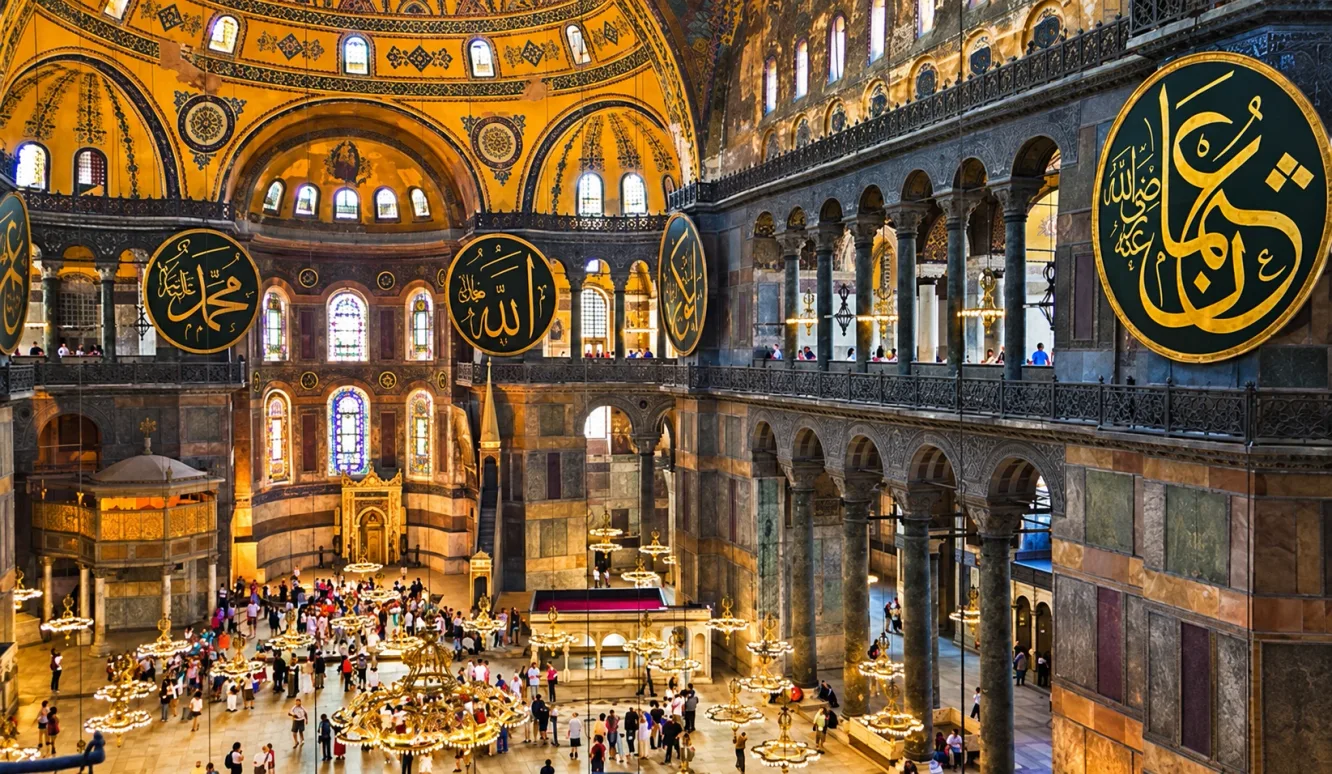
Hagia Sophia: The Mosque Spiritual Atmosphere
Ultimately, the re-opening of the Hagia Sophia for prayer transformed it back into a living manifestation of monotheism. It bridged the silence gap of the 20th century, re-aligning the Turkish Republic with its imperial spiritual legacy.
To step inside today, is to witness a space that has regained its acoustic and spiritual purpose. The “Holy Wisdom” is no longer a whisper among tourists, but a resonant chant that connects the modern believer to the first prostrations of 1453.
The first Friday prayers after 85 years: On the 24th July 2020, the world watched the first Friday prayers after 85 years of silence. The call to prayer (Azan, also written Adhan) echoed once again from the four minarets, signaling a definitive end of silence.
UNESCO Site: The Turkish government maintained that the building remains a UNESCO World Heritage site. Because Islamic tradition generally does not allow figural images during prayer, The Christian mosaics are preserved and simply covered by curtains during prayer times, allowing the building to hold both its Roman and Ottoman histories simultaneously.
The 2020 Verdict: Legally, Hagia Sophia is a Waqf property “endowment”. Its status cannot be
changed. Returning it to a mosque was seen as fulfilling the “will of the Mohammad II”.
When Minarets Breathe the “Azan”: The Sound and Call of the Divine
In Islam, prayer (Salat) is a direct connection between the human being (creature) and God (Allah, the Creator of the Universe and all beings). It is the spiritual heartbeat of a Muslim's daily life. Performed five times a day, it serves as an unmediated link pulling the believer away from the chaotic rush of ordinary life into a state of profound mindfulness.
It is an act of total surrender and equality, where all believers stand shoulder to shoulder in identical submission. This daily cycle turns time itself into a sacred journey set in motion by a single, mesmerizing human voice: the “Azan”, the Islamic call to prayer. To the traveler standing in the shadow of great minarets, the Azan is often their first and most profound sensory encounter with Islamic culture. It is a lyrical proclamation of faith delivered with raw human emotion.
What Does the Azan Call Mean?
The Azan is not only a call for prayer, it is a declaration of the absolute oneness of God, a testament to His ultimate greatness, and an open, universal invitation to all believers to pause, leave their burdens behind, and come to pray together and enter a state inner peace.
This is the true success (Falah). It is the echo that resonates with the Divine Wisdom.
| Allahu Akbar.. (repeated 2 times) | Allah is the Greatest. Declaring God the Creator transcends all worldly worries. |
| Ash-hadu alla ilaha illallah (repeated 2 times) | I bear witness that there is no deity but Allah. The core testimony of monotheism. |
| Ash-hadu anna Muhammadan Rasoolullah (repeated 2 times) | I bear witness that Muhammad is the Messenger of Allah. Affirming the prophetic guidance that delivered the Divine Message of Islam (Submission to one and only one indivisible God, Allah). |
| Hayya ‘alas-salah (repeated 2 times) | Come to prayer – A physical invitation to stand before the Divine. |
| Hayya ‘alal-falah (repeated 2 times) | Come to success – A spiritual promise that true fulfillment lies in worship. |
| Allahu Akbar.. Allahu Akbar.. La ilaha illallah | God is the Greatest (repeated 2 times). There is no deity but Allah. – A final, unifying echo of the beginning. |
Hagia Sophia’s Mosaics & Iconoclasm
The Iconoclastic Movement (726–843 CE):
“Iconoclasm” literally means image-breaking. For over a century (spanning roughly 117 years across two waves), Roman emperors banned human and divine figures (icons) in churches. Inside Hagia Sophia, portraits and mosaics featuring Jesus, Mary, and saints were scraped off, plastered over, or replaced with simple, non-figurative symbols
The Post-Iconoclastic Revival (843 CE Onward)
When the ban on icons was lifted in 843 CE (celebrated as the “Triumph of Orthodoxy”), emperors spent centuries adding world-famous figurative masterpieces over the old gold background.
Must-See Mosaics
1. The Apse Mosaic (867 CE): The Virgin Mary and Child, installed specifically to replace the Iconoclastic cross.
2. The Deësis Mosaic (c. 1261 CE): Located in the upper South Gallery, famous for its incredible emotional realism and detail.
3. The Imperial Door & Southwest Vestibule Mosaics: Showing Byzantine emperors bowing before Christ or offering models of the city and church to Mary.
Gradual Covering & Preservation:
Rather than destroying the figural mosaics, Ottoman authorities gradually covered them over the course of centuries with protective layers of plaster and decorative whitewash or stenciled designs. During the major 1847– 1849 restoration under Sultan Abdülmecid I, architects uncovered, cleaned, and documented these hidden works before re-plastering them.
20th Century Uncovering and Museum Status:
The systematic restoration and uncovering of the hidden mosaics began in 1931 to convert the building into a museum in 1934, officially opening its doors to the public in 1935.
Now: Apse Mosaic (Virgin Mary and Child): Covered by automated textile curtains or drapes. These curtains are closed during Islamic prayer times to align with iconographic requirements in Muslim worship spaces.
This source page contains an illustration with no body text.
In fact, the final transition of Hagia Sophia represents
a shift from the Trinitarian theology to the absolute
oneness of God (Tawhid, pronounced Tawheed).
It challenged the Nicene Trinitarian creed, echoing
the historical critiques of early Arianism and
the subsequent Unitarian movements within
Christianity.
End of this section