THE POCKET GUIDE · 02 · PAGES 29–42
The Early Churches
Three churches, one extraordinary site. The making of an architectural masterpiece.
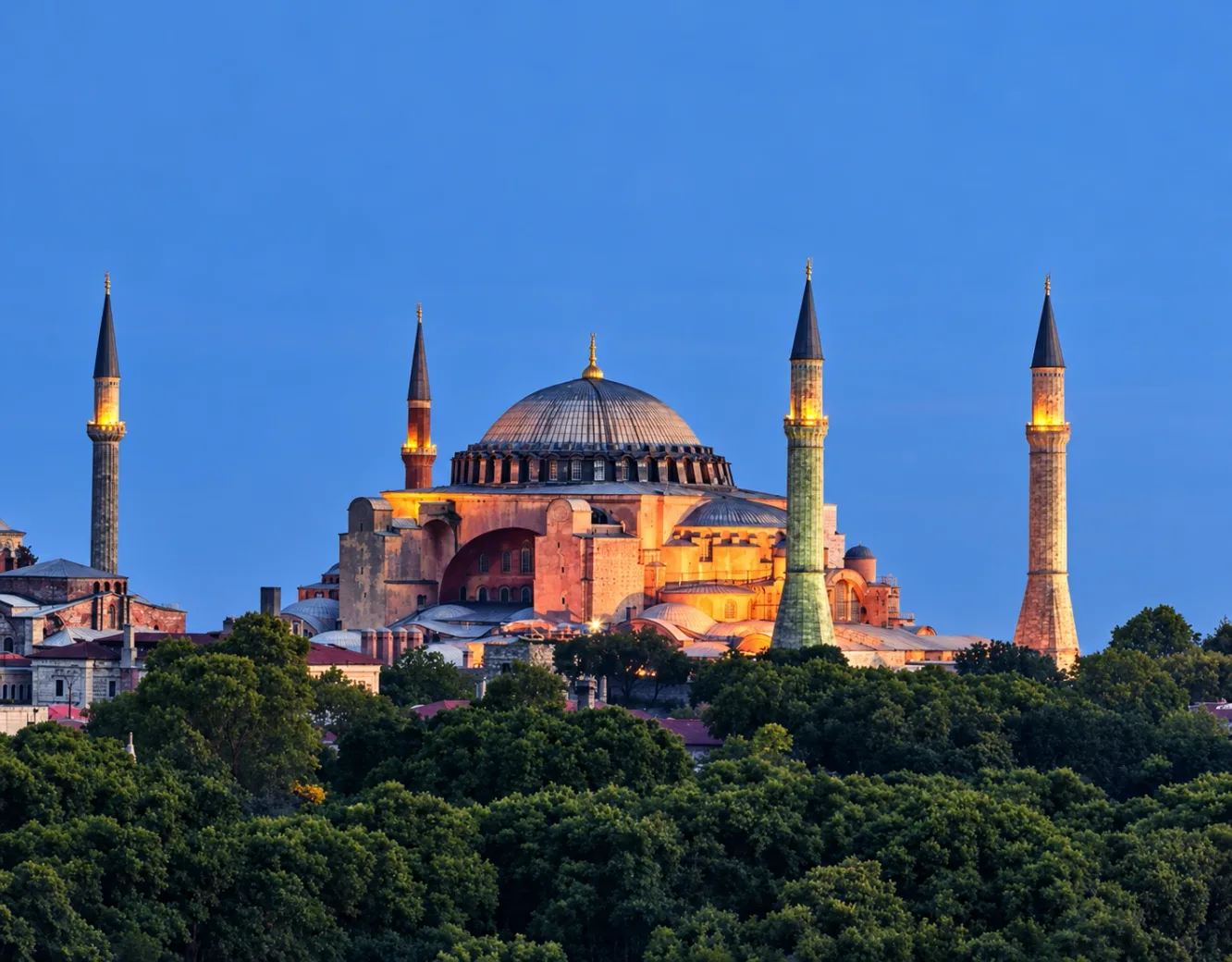
The complete original English text. Historical and theological commentary reflects the perspective of the source publication.
Contents & navigation
Hagia Sophia: The Early Churches
Arianism Trinitarianism
2.1 The First of three Churches
Constantine I wasn’t just a builder of cities; he was a builder of order. On the site where the Hagia Sophia stands today, his son Constantius II commissioned the first great church (often called the Great Church, Megale Ekklesia) on February 15, 360 CE. This was the first of the three churches built on the same site. (Constantius II was a devout Arian nontrinitarian Christian).
Many readers will be surprised to learn that for several decades, Constantinople was an Arian city. The “Great Church” (the first Hagia Sophia) was often led by Arian nontrinitarian bishops.
High-ranking officials and the Germanic tribes who protected the city were almost all Arians.
To them, the Trinity was a “Greek philosophical invention” that complicated the simple monotheism they found in the scriptures.
The “Arian Era” was ended abruptly by Theodo-sius I (Theodosius the Great) in 379 CE. He was a hardcore Trinitarian. He issued the Edict of Thessalonica, which made Trinitarianism the only legal religion of the Empire.
30 https://muze.gen.tr/muze-detay/ayasofya
2.2 The Second Church on the Same
Site (Built by Theodosius II, 415 CE)
The first church was destroyed in a fire in 404 CE. It was replaced by the Second Hagia Sophia, built by Theodosius II. The church was inaugurated on October 10, 415 CE.
By this time, the Council of Constantinople (381 CE) had expanded the Nicene Creed solidifying the Trinity as we know it today. The Arian bishops were expelled, and their followers were marginalized. The Hagia Sophia became the official “Fortress of the Trinity.”
The second Hagia Sophia was also a wooden-roofed basilica, but much grander, with a monumental entrance decorated with marble carvings of sheep (representing the Apostles). You can still see some of these marble fragments today if you visit the garden of the current Hagia Sophia.
www.pallasweb.com
2.3 The Third Church on the Same Site: (Built by Justinian I, 537 CE)
Unfortunately, Constantinople faced massive riots known as the Nika Riots (532 CE) that burned down nearly half of the city including the second church. From these ashes, Justinian-I would build the third and final Hagia Sophia— the one that stands today.
The third (and current) Hagia Sophia in Istanbul was built between 532 and 537 CE. It was officially openned on 27th December, 537 CE.
Named Hagia Sophia in 430 CE: The Hagia Sophia (meaning “Holy Wisdom” in Greek) officially received its famous name around 430 CE.
Originally called the Megale Ekklesia (Great Church) when it was first built by Emperor Constantius in 360 CE, the structure was later dedicated to “Holy Wisdom” as the church was rebuilt and expanded.
potlight -1
Theodosius Walls and Hagia Sophia
The walls are named after Emperor Theodosius II, who ruled the Eastern Roman Empire in the early 5th century (408–450 CE). While Constantine the Great built the first set of walls for his new capital, the city grew so rapidly that it quickly “outgrew” its original boundaries.
1. The Great Expansion (413 CE): By the time Theodosius II was a young emperor, the population of Constantinople had exploded. The original walls of Constantine were too close to the city center. Theodosius II (under the guidance of his advisor, Anthemius) ordered the construction of a new line of defense about 1.5 kilometers (1 mile) west of the old walls.
This move effectively doubled the size of the city, providing a massive “buffer zone” and room for the city to flourish for the next thousand years.
2. A Masterpiece of Engineering:
The “Theodosian Walls” aren’t just a single wall; they are a complex, triple-layered defense system designed to be impossible to breach.
The Moat: A deep, wide trench filled with water to stop siege engines.
The Outer Wall: A smaller wall used by archers to pick off soldiers who made it across the moat.
The Inner Wall (The Main Wall): This was the massive structure, standing nearly 12 meters (40 feet) high and 5 meters (16 feet) thick, reinforced with 96 massive towers.
3. Resilience Through Earthquakes:
In 447 CE, shortly after the walls were finished, a massive earthquake leveled many of the towers to the ground. In an incredible feat of communal labor, the citizens of Constantinople rebuilt the entire fortification system in just 60 days, making it even stronger than before by adding the outer wall and moat we see today.
potlight - 2
Theodosius II ruled for a remarkably long time (408–450 CE). He was a massive builder and organizer. He built the famous Theodosian Walls a triple-layer defense system that made the city the most un-takeable fortress in the world. In addition, he built the second Hagia Sophia in 415 CE. The entrance of this church was decorated with marble carvings of sheep (representing the Apostles). You can still see them today left in the outside garden of the current Hagia Sophia.
Note: Theodosius I was the last emperor to rule a truly united Roman Empire. As he lay dying in Milan in January 395 CE, he officially decreed that the empire be divided between his two sons: Arcadius who ruled the eastern part and Honorius who ruled the Western part. In 408 CE, Arcadius died and his son Theodosius II took over.
“The Gate of the Conquest, historically known as the Gate of Saint Romanus, is called today in Istanbul the ‘Topkapı Gate’ (the Cannon Gate). It received this name because it was the area where the Ottomans focused their bombardment with massive cannons to breach the city walls.”
potlight - 3
Hagia Irene (Aya İrini)
As the first church built in Constantinople, Hagia Irene (Holy Peace) was commissioned by Constantine I in the 320s CE and served as the imperial capital’s primary cathedral before the erection of Hagia Sophia in 360 CE.
Rebuilt by Justinian I following the 532 CE Nika Riots, the domed basilica holds a unique place in Istanbul’s architectural heritage: it was never converted into a mosque following the 1453 Ottoman conquest.
Instead, situated within the outer courtyard of Topkapı Palace, it served as the imperial armory and later as the empire’s first military museum.
Today, it stands extraordinarily preserved, featuring a rare Iconoclastic-era mosaic cross in its apse.
This source page contains an illustration with no body text.
potlight - 4
Hagia Sophia: Catholic or Orthodox?
During the time of Constantine -I, there was no “Catholic Church” in the West versus an “Orthodox Church” in the East. There was only one state church, and both sides called themselves Catholic (meaning “universal”) and Orthodox (meaning “right-believing”).
The West (Rome): Over centuries, the Bishop
of Rome (the Pope) claimed supreme authority over all Christians. The West continued to use the title Catholic as their primary identifier to emphasize their “universal” jurisdiction under the Pope.
The East (Constantinople): The Patriarch
of Constantinople and other Eastern bishops rejected the Pope’s claim of absolute power. They began to emphasize the title Orthodox to signal that they were the ones preserving the “original, unchanged” traditions of the early Church.
Hagia Sophia was neither “Catholic” nor “Orthodox” in the way we use those labels today, it was simply “Christian” until the Great Schism of 1054 CE. From its construction in 537 until 1054, Hagia Sophia was the heart of a single, undivided Christian world.
| Feature | The Western Romans | The Eastern Romans (Byzantine) |
| Primary Title | Catholic | Orthodox |
| Center of Power | Rome | Constantinople |
| Language of Liturgy (worship) | Latin | Greek |
| Leadership | The Pope (Single Head) | The Patriarchs (Group of Leaders) |
Editorial image noteFull-page illustration of mounted Crusaders wearing white cloaks with red crosses.
End of this section